-
Linear Regression – Assumption – 3(How To Detect & Avoid Non Normal Distribution Of Error Term ?)
-

Linear Regression – Assumption – 2 (How To Detect & Avoid Multicollinearity ?)
Linear Regression – Assumption- 2 (How To Detect & Avoid Multicollinearity ?) Table Of Contents: How To Detect Multicollinearity In The Dataset ? Correlation Matrix. Variance Inflection Factor Model Behavior Observation. How To Avoid Multicollinearity In The Dataset ? Remove One of the Correlated Variables Use Principal Component Analysis (PCA) Use Regularization Techniques (Ridge/Lasso) (1) How To Detect Multicollinearity In The Dataset? Method – 1: Correlation Matrix (Pearson correlation) We will use Pearson ‘r’ Correlation Coefficient to find the correlation between two variable. import seaborn as sns import matplotlib.pyplot as plt # Load dataset tips = sns.load_dataset(“tips”) # Compute the
-
Linear Regression – Assumption -2 (No Multicollinearity)
-

Linear Regression – Assumption- 1 (Linear Relationship)
Linear Regression – Assumption- 1 (Linear Relationship) Table Of Contents: What Is Linear Relationship Assumption ? Why Linear Regression Assumption Is Important ? How To Check Linearity Between Dependent & Independent Variable ? How The Residuals Can Say About The Linearity ? What To Do If You Have Non Linearity Present In The Data ? (1) What Is Linear Relationship Assumption ? (2) What Is Linear Relationship Assumption Important ? (3) How To Check Linearity Between Dependent & Independent Variable ? (1) Using Scatter Plot import seaborn as sns import matplotlib.pyplot as plt # Load a real dataset tips =
-

Linear Regression – Interview Questions On Linear Regression.
Interview Questions On Linear Regression. Table Of Contents: What is linear regression? Explain the assumptions of a linear regression model. What is the difference between simple and multiple linear regression? What is multicollinearity, and how do you detect it? What are residuals in linear regression? What is the cost function used in linear regression? How do you find the optimal parameters in linear regression? Explain the formula for the regression line. What is R-squared? What is the adjusted R-squared, and why is it important? How do you handle categorical variables in linear regression? What would you do if your model
-
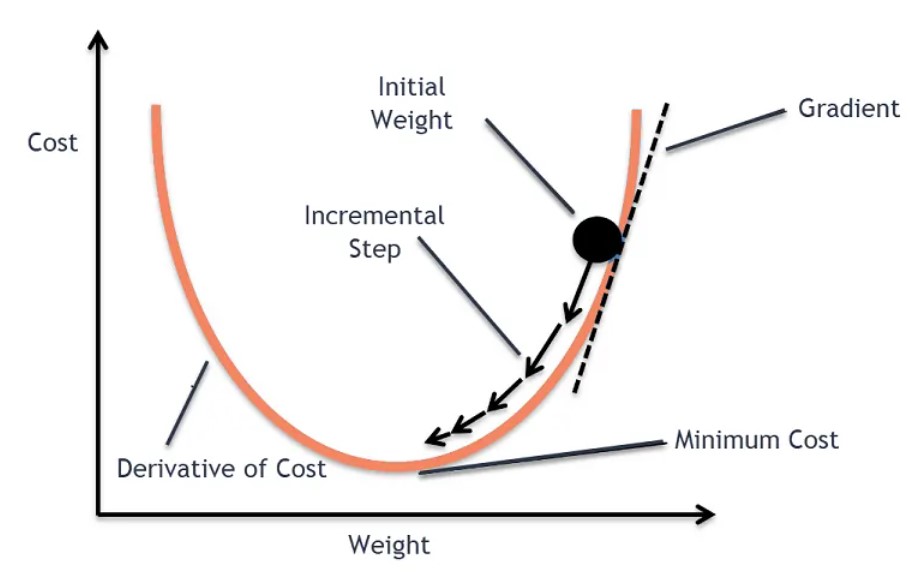
Linear Regression : Why We Don’t Use Gradient Descent Algorithm In Linear Regression?
Why We Don’t Use Gradient Descent Algorithm In Linear Regression? Table Of Contents: hI (1) Reason We do apply gradient descent to linear regression, but often it’s not necessary because linear regression has a closed-form solution that is computationally efficient for small to medium-sized datasets. Let me explain: Closed-Form Solution for Linear Regression Here we can directly take the derivative of the Loss function and equate it to zero. Then we can solve the equation to get the optimal value of the beta. How Can We Directly Equate A Single Derivative To Zero To Get The Beta Value. We can
-
Linear Regression – (R – Squared and Adjusted R – Squared)
R- Squared and Adjusted R-Squared Table Of Contents: What Is R-Squared Value? Formula For R-Squared Value. Interpretation Of R-Squared Value. Example Of R-Squared. Key Points To Note. Conclusion. (1) What Is R-Squared Value? R-squared, also known as the coefficient of determination, is a statistical measure that shows how well the independent variable(s) in a regression model explain the variability of the dependent variable. It provides an indication of the model’s goodness of fit. (2) Formula For R Squared Value (3) Interpretation Of R-Squared (4) Example Of R-Squared (5) Key Points To Note (6) Conclusion (7) Adjusted R-Squared Adjusted R-squared is
-

Linear Regression – Topics
Linear Regression Topics Table Of Contents: Basics of Linear Regression Model Components Assumptions of Linear Regression Diagnostics Violations of Assumptions Statistical Concepts Model Evaluation Extensions and Variants Feature Engineering for Linear Regression Advanced Topics (1) Basics Of Linear Regression (2) Assumptions of Linear Regression (3) Model Components (4) Statistical Concepts (5) Diagnostics (6) Extensions and Variants (7) Model Evaluation (8) Violations of Assumptions (9) Feature Engineering for Linear Regression (10) Advanced Topics
-

Linear Regression – Assumption – 5 (Autocorrelation In Regression)
Autocorrelation Table Of Contents: What Is Autocorrelation? Assumption Of No Autocorrelation. Why No Autocorrelation Is Important? Common Causes Of Autocorrelation. Detecting Autocorrelation. Addressing Autocorrelation. Examples Of Autocorrelation In Residuals. (1) What Is Autocorrelation? In linear regression, autocorrelation refers to the correlation of the residuals (errors) of the model with themselves, particularly in time-series data or data with a sequential nature. The assumption of no autocorrelation is one of the key assumptions for the validity of a linear regression model. (2) Assumption Of No Autocorrelation. (3) Why No Autocorrelation Is Important? (4) Common Causes Of Autocorrelation. Omitted Variables: Missing important predictors
-

Linear Regression – Assumption – 4 (Homoscedasticity In Details?)
Homoscedasticity Table Of Contents: What Is Homoscedasticity ? Why Is Homoscedasticity Important? How to Identify Homoscedasticity? Examples Of Homoscedasticity . Consequences of Violating Homoscedasticity. How to Fix Heteroscedasticity? In Summary. (1) What Is Homoscedasticity? Homoscedasticity is an assumption in linear regression that the variance of the errors (residuals) is constant across all levels of the independent variables. In other words, the spread of residuals should be roughly the same for all predicted values of the dependent variable. (2) Why Is Homoscedasticity Important? Homoscedasticity is a key assumption in linear regression because: Accuracy of Predictions: When the variance of residuals is