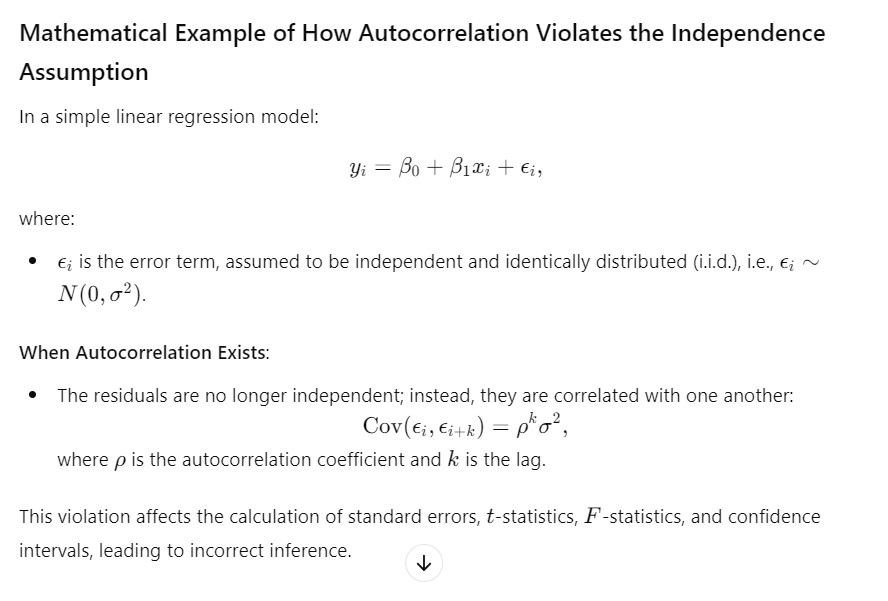
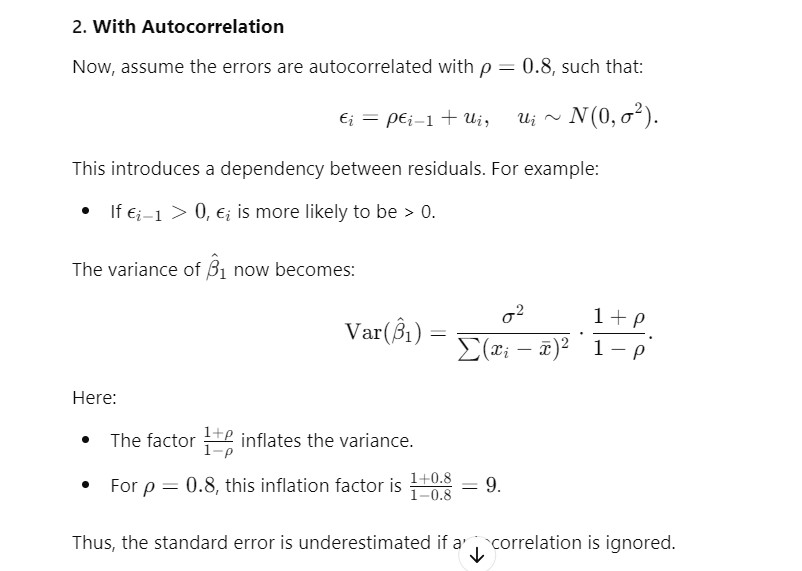
In linear regression, autocorrelation refers to the correlation of the residuals (errors) of the model with themselves, particularly in time-series data or data with a sequential nature.
The assumption of no autocorrelation is one of the key assumptions for the validity of a linear regression model.
(2) Assumption Of No Autocorrelation.
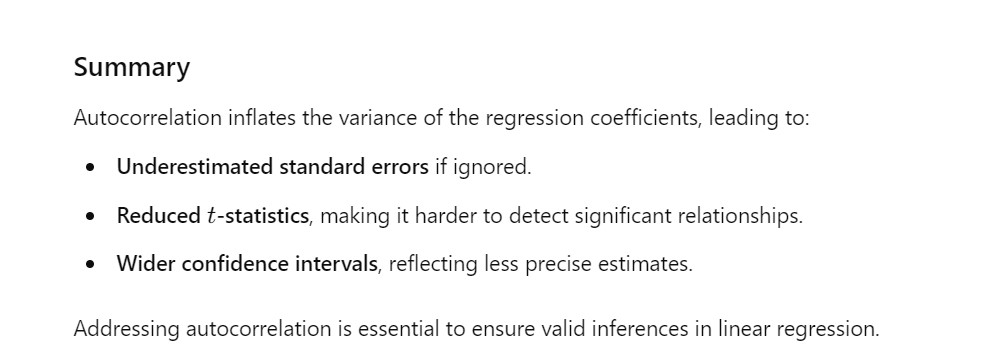
(3) Why No Autocorrelation Is Important?
(4) Common Causes Of Autocorrelation.
Omitted Variables:
Missing important predictors that are correlated with the dependent variable.
Misspecified Model:
Using an incorrect functional form or missing time-lagged relationships in time-series data.
Measurement Errors:
Errors in data collection can introduce patterns in residuals.
Time-Series or Sequential Data:
Observations close in time or sequence are often correlated.
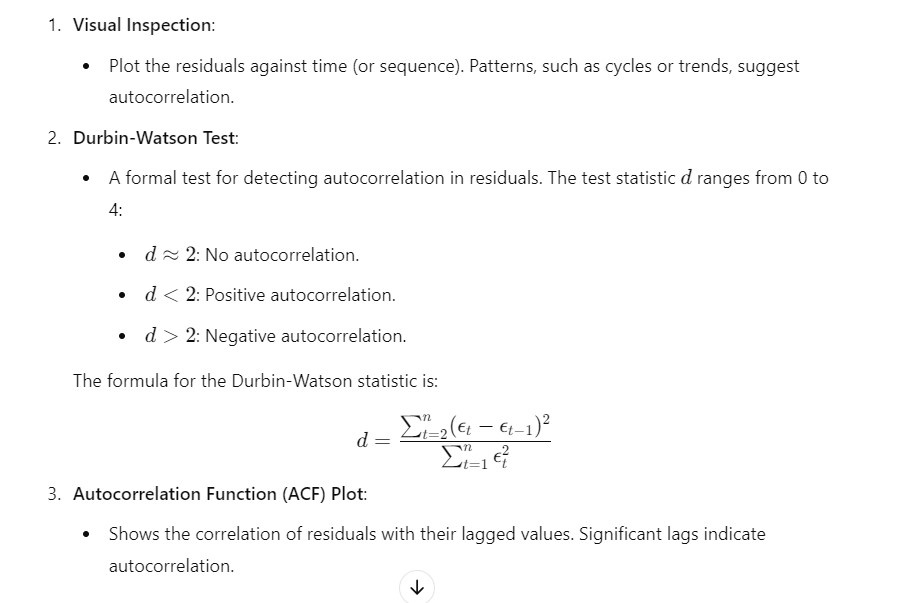
(5) Detecting Autocorrelation.
(6) Addressing Autocorrelation.
Add Lagged Variables:
Include lagged dependent or independent variables to account for temporal effects.
Transform Variables:
Use differencing or other transformations to remove trends or cycles.
Generalized Least Squares (GLS):
Modify the regression approach to account for correlated residuals.
Use Time-Series Models:
For strongly autocorrelated data, consider models like ARIMA (Auto-Regressive Integrated Moving Average) or similar time-series-specific models.
Clustered Standard Errors:
Adjust standard errors to account for autocorrelation, particularly in panel data.