text = """
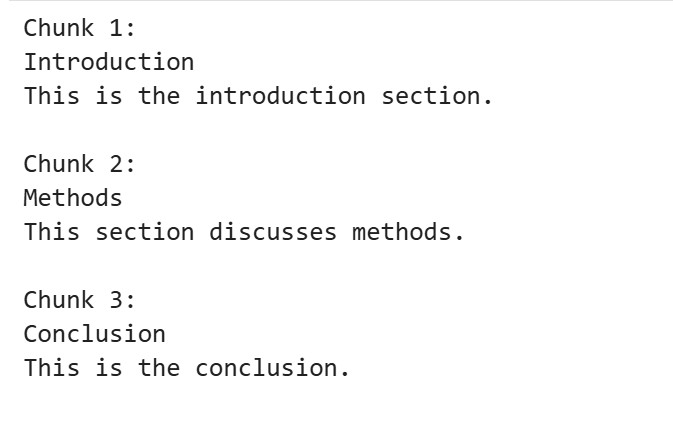
# Introduction
This is the introduction section.

# Methods
This section discusses methods.

# Conclusion
This is the conclusion.
"""

# Chunk using "#" as the delimiter
chunks = text.split("# ")
chunks = [chunk.strip() for chunk in chunks if chunk.strip()]

for i, chunk in enumerate(chunks):
    print(f"Chunk {i+1}:\n{chunk}\n")
Example 2: Chunking Chat Transcripts
chat_log = "User: Hi\nBot: Hello!\nUser: What’s the weather?\nBot: It's sunny today."

# Split by newline to separate turns
chunks = chat_log.split('\n')

for i, chunk in enumerate(chunks):
    print(f"Turn {i+1}: {chunk}")
Example 3: Chunking Logs or CSV Rows
log_text = """2023-01-01: System started
2023-01-01: User logged in
2023-01-01: Error occurred"""

# Split each log entry using newline
chunks = log_text.split('\n')

for i, chunk in enumerate(chunks):
    print(f"Log Entry {i+1}: {chunk}")
Example 4: Custom Delimiter (=== END ===)
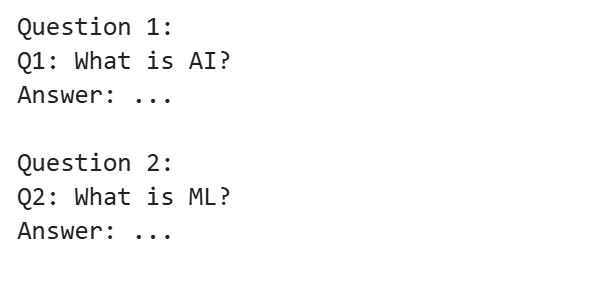
data = "Q1: What is AI?\nAnswer: ...=== END ===Q2: What is ML?\nAnswer: ..."

# Use custom delimiter
chunks = data.split("=== END ===")

for i, chunk in enumerate(chunks):
    print(f"Question {i+1}:\n{chunk.strip()}\n")