from __future__ import annotations

import asyncio
import json
import logging
import re
from pathlib import Path
from typing import Any

from langchain_text_splitters import MarkdownHeaderTextSplitter, RecursiveCharacterTextSplitter

from rag_pipeline.chunking.helpers import (
    _split_table,
    _is_markdown_table,
    _clean_file_name,
    _context_prefix,
    _merge_meta_keep_earliest,
    _get_chunking_config
)
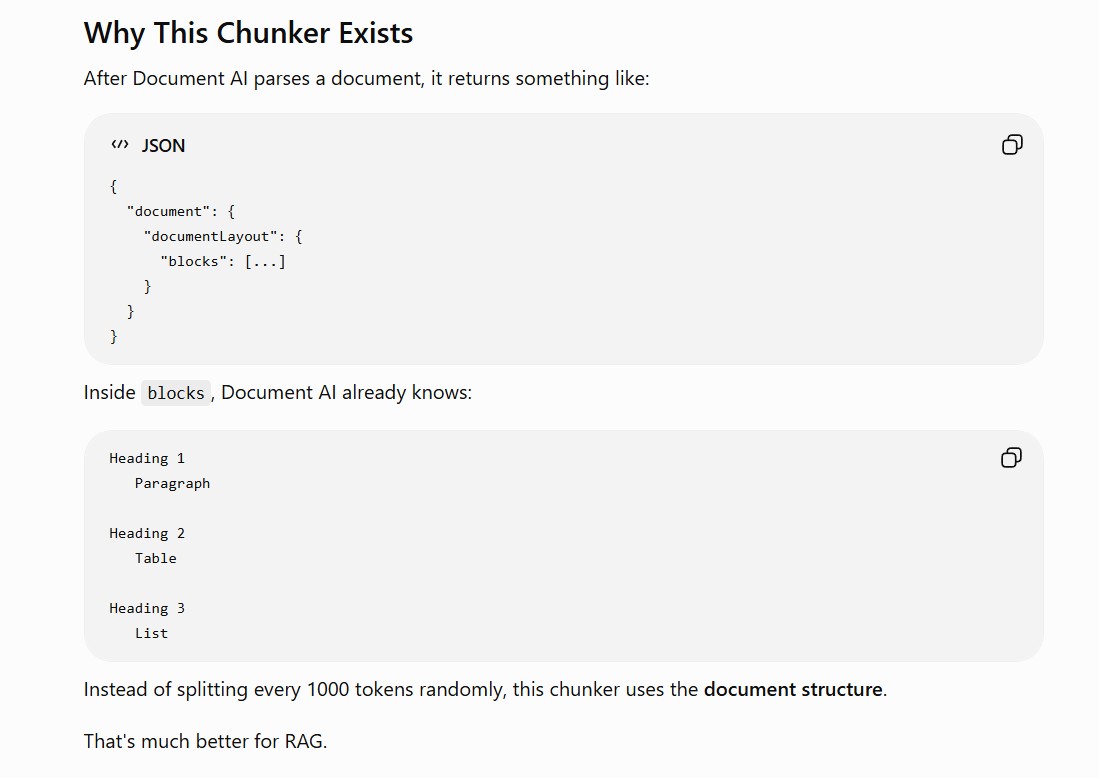
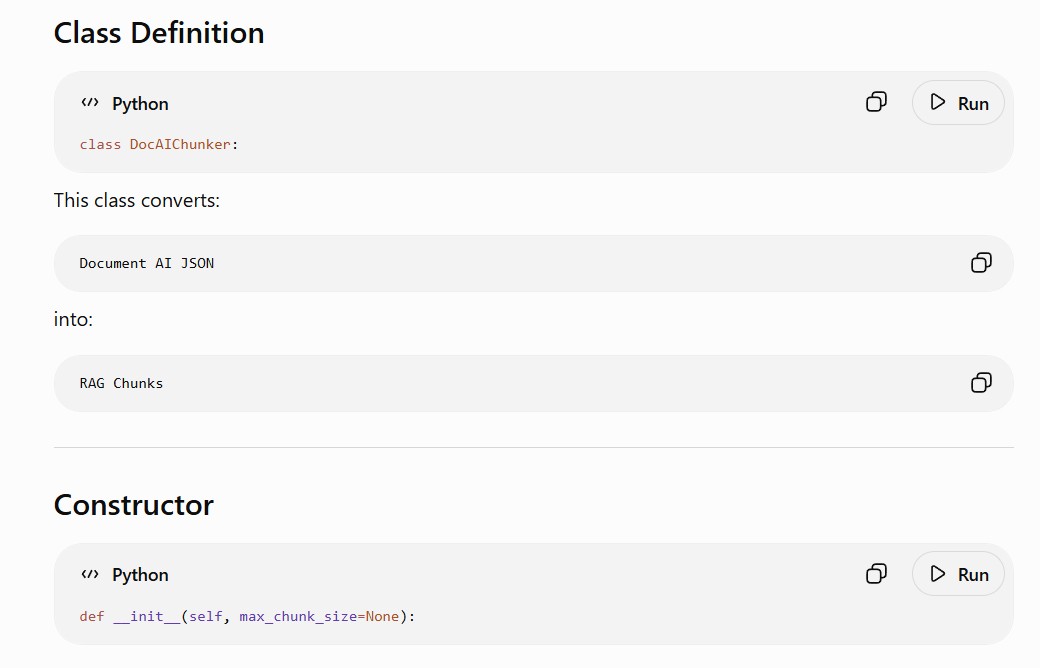
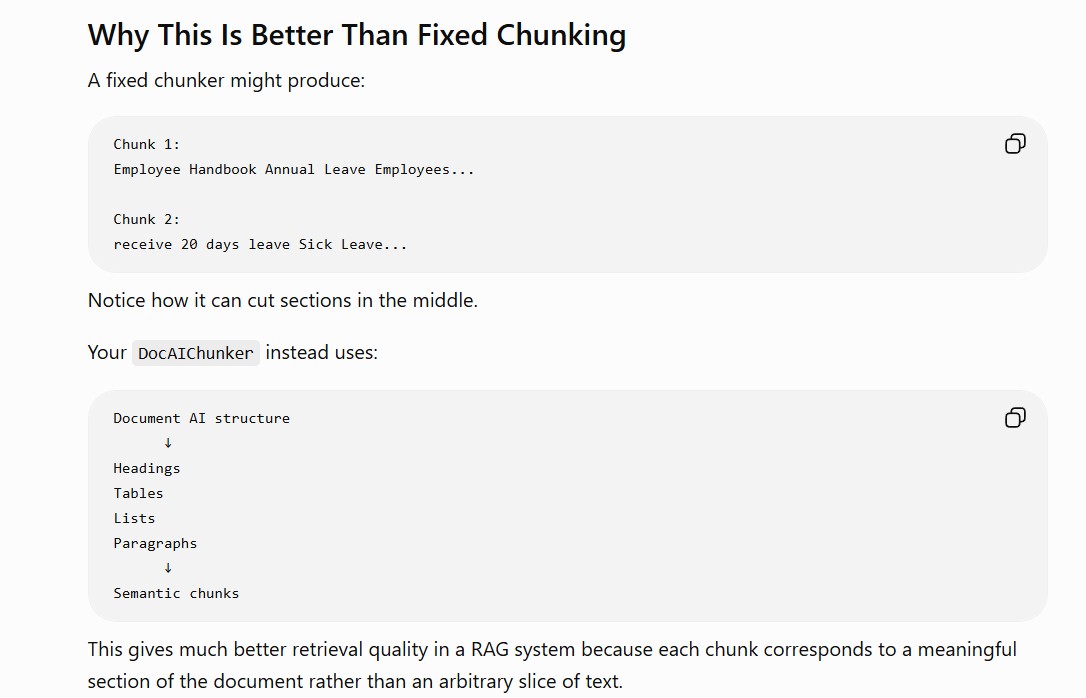
from rag_pipeline.chunking.docai_chunker import DocAIChunker
from rag_pipeline.config import get_settings
from rag_pipeline.parsing.helpers import _error_payload
from rag_pipeline.utils.gcs import GCSBucketConnector


class DocumentChunker:
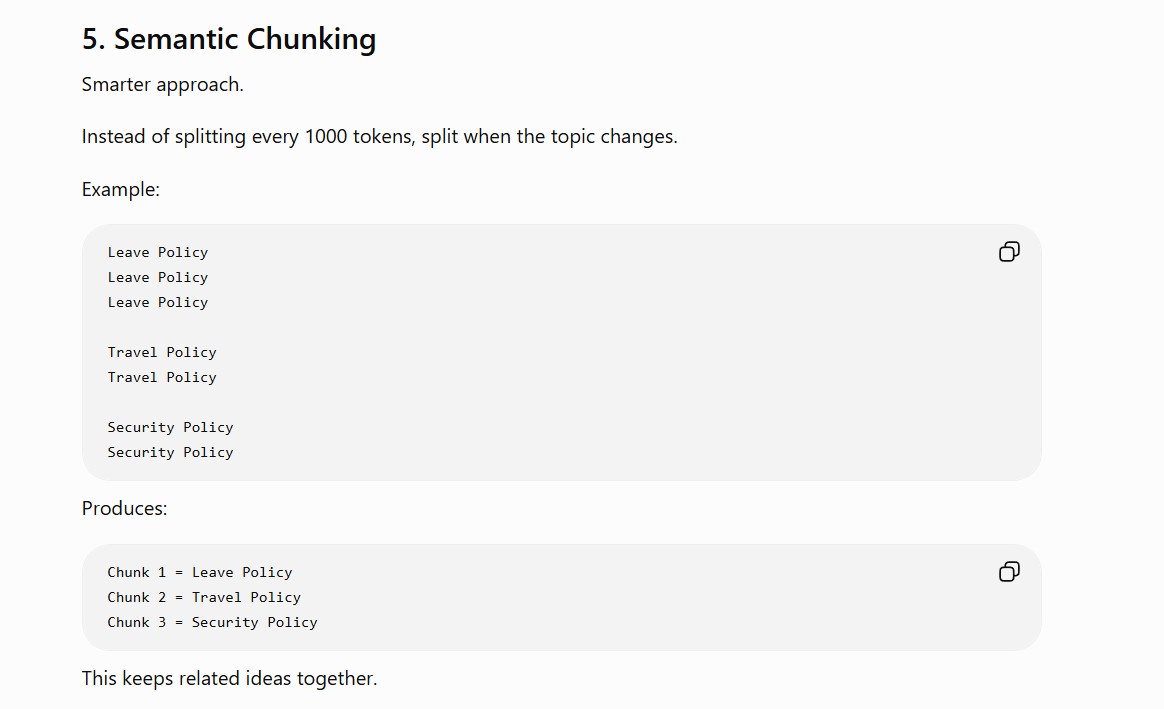
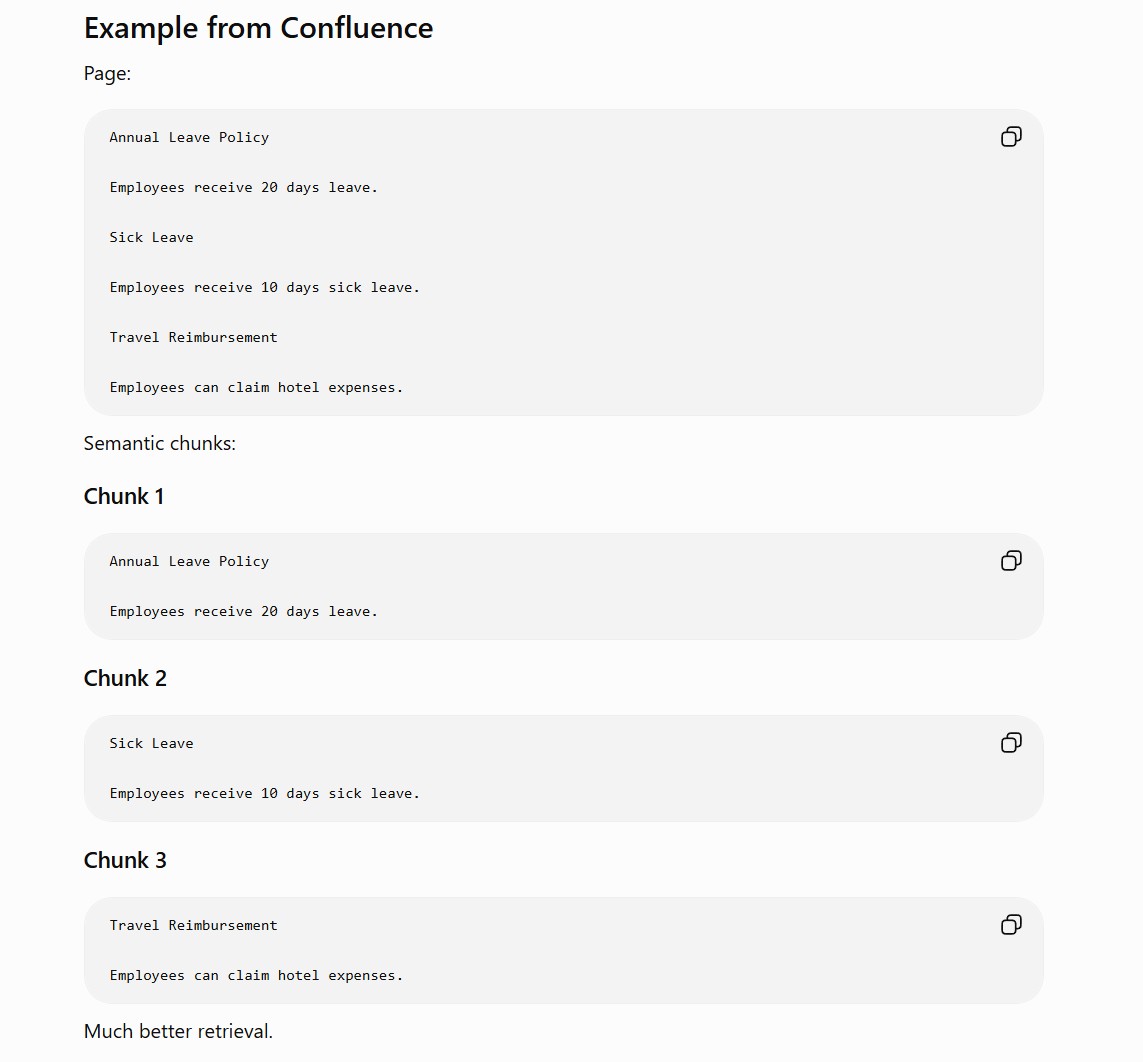
    """Hierarchical markdown chunker with table-aware splitting and breadcrumb context."""

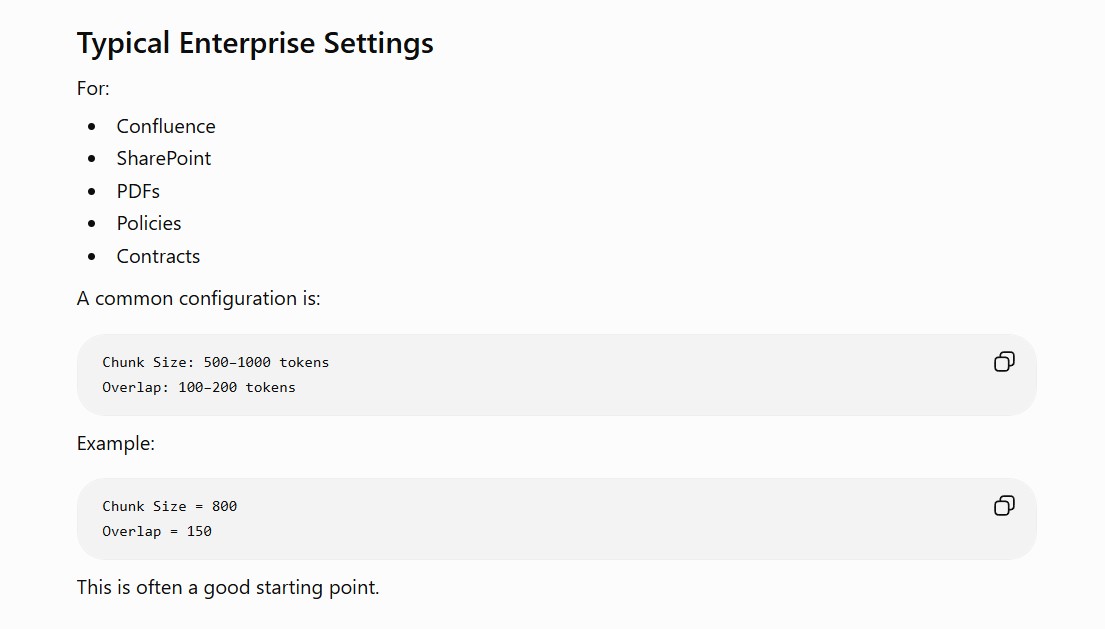
    def __init__(self, max_chars: int | None = None, overlap: int | None = None):
        """Initialize chunker with optional config overrides.

        Args:
            max_chars: Max characters per chunk (loads from config if None)
            overlap: Overlap characters between chunks (loads from config if None)
        """
        self.logger = logging.getLogger(__name__)
        config_max_chars, config_overlap, self.headers = _get_chunking_config()
        self.max_chars = max_chars or config_max_chars
        self.overlap = overlap or config_overlap

        self.char_splitter = RecursiveCharacterTextSplitter(
            chunk_size=self.max_chars,
            chunk_overlap=self.overlap,
            separators=["\n\n", "\n", ". ", " ", ""],
            length_function=len,
        )

    def _header_split(self, text: str) -> list[Any]:
        """Split by headers progressively, expanding only oversized sections."""
        # Start coarse (H1 only), then progressively split only oversized sections.
        docs = MarkdownHeaderTextSplitter(headers_to_split_on=self.headers[:1], strip_headers=False).split_text(text)
        for level in range(1, len(self.headers)):
            expanded = []
            for d in docs:
                if len(d.page_content) <= self.max_chars:
                    expanded.append(d)
                    continue
                sub = MarkdownHeaderTextSplitter(
                    headers_to_split_on=self.headers[:level + 1], strip_headers=False
                ).split_text(d.page_content)
                for s in sub:
                    # Preserve parent header metadata on child sections.
                    s.metadata = {**d.metadata, **s.metadata}
                expanded.extend(sub)
            docs = expanded
        return docs

    def _hydrate_header_context(self, docs: list[Any]) -> list[Any]:
        """Fill missing parent headers so lower-level chunks carry full available hierarchy."""
        last_seen: dict[str, str] = {}
        hydrated = []
        for d in docs:
            meta = dict(d.metadata or {})

            if meta.get("h1"):
                last_seen["h1"] = meta["h1"]
                last_seen.pop("h2", None)
                last_seen.pop("h3", None)
                last_seen.pop("h4", None)
            elif last_seen.get("h1"):
                meta["h1"] = last_seen["h1"]

            if meta.get("h2"):
                last_seen["h2"] = meta["h2"]
                last_seen.pop("h3", None)
                last_seen.pop("h4", None)
            elif (meta.get("h3") or meta.get("h4")) and last_seen.get("h2"):
                meta["h2"] = last_seen["h2"]

            if meta.get("h3"):
                last_seen["h3"] = meta["h3"]
                last_seen.pop("h4", None)
            elif meta.get("h4") and last_seen.get("h3"):
                meta["h3"] = last_seen["h3"]

            if meta.get("h4"):
                last_seen["h4"] = meta["h4"]

            d.metadata = meta
            hydrated.append(d)
        return hydrated

    def _split_content(self, content: str) -> list[str]:
        """Split section content; do not inject context here."""
        if len(content) <= self.max_chars:
            return [content]

        pieces: list[str] = []
        # Table detection regex
        TABLE_RE = re.compile(r"((?:^\|.*\|\s*$\n?){2,})", re.MULTILINE)

        # Split around table-shaped blocks so we can treat tables differently.
        segments = TABLE_RE.split(content)
        for seg in segments:
            if not seg or not seg.strip():
                continue
            if TABLE_RE.fullmatch(seg) and _is_markdown_table(seg):
                if len(seg) > self.max_chars:
                    # Oversized tables are split row-wise with header repetition.
                    pieces.extend(_split_table(seg, self.max_chars))
                else:
                    pieces.append(seg)
                continue
            # Non-table text uses recursive character splitting.
            for chunk in self.char_splitter.split_text(seg):
                if chunk and chunk.strip():
                    pieces.append(chunk)

        coalesced: list[str] = []
        for piece in pieces:
            if not coalesced:
                coalesced.append(piece)
                continue
            candidate = f"{coalesced[-1]}\n\n{piece}"
            if len(candidate) <= self.max_chars:
                # Opportunistically re-join neighboring fragments when safe.
                coalesced[-1] = candidate
            else:
                coalesced.append(piece)

        return coalesced

    def chunk(self, markdown_text: str, file_name: str) -> list[dict[str, Any]]:
        """Chunk markdown text using header/table-aware splitting.

        Returns list of dicts with source, hierarchical metadata, and chunk body.

        Args:
            markdown_text: Markdown content to chunk
            file_name: Source file name (used for metadata)

        Returns:
            list: Dicts with keys: file_name, chunk_id, h1-h4 (if present), body
        """
        text = str(markdown_text or "").replace("\r\n", "\n").replace("\r", "\n")
        if not text.strip():
            return []

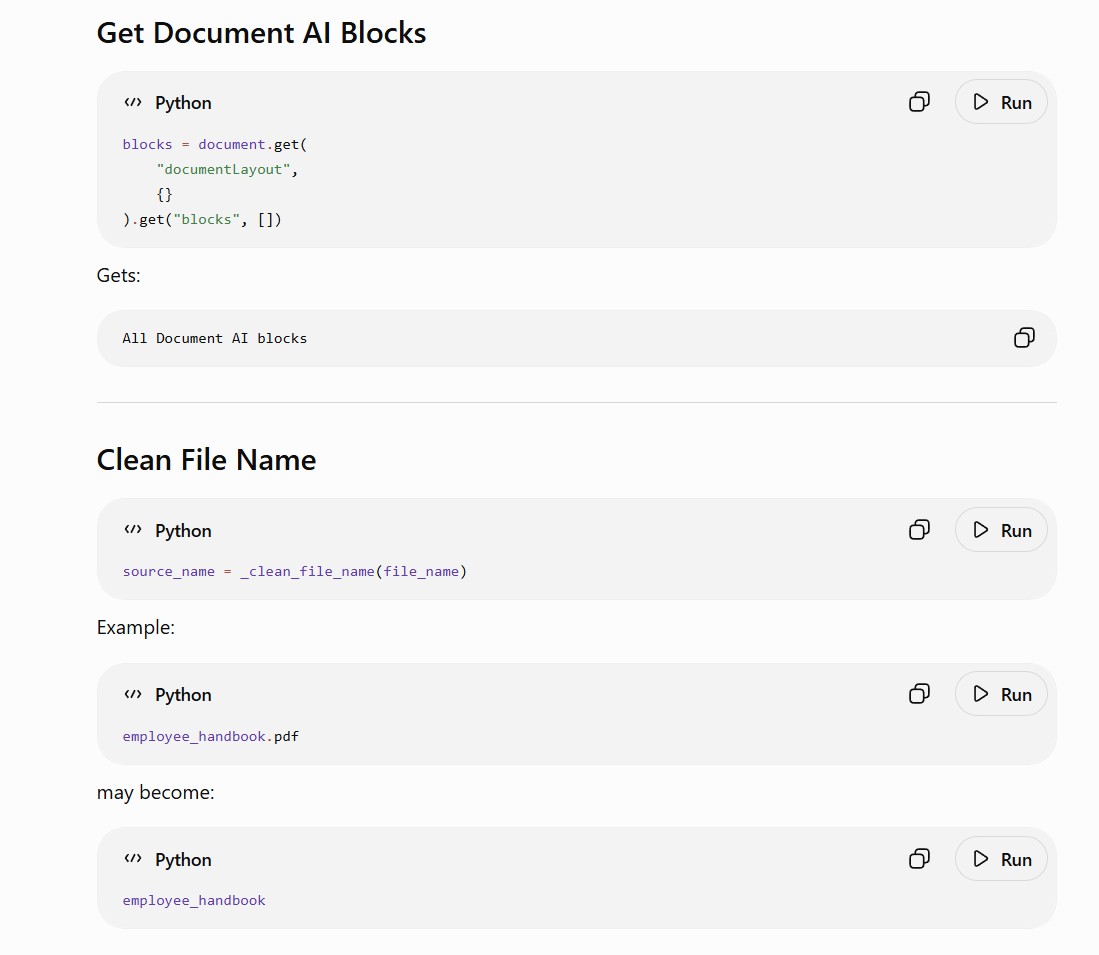
        source_name = _clean_file_name(file_name)
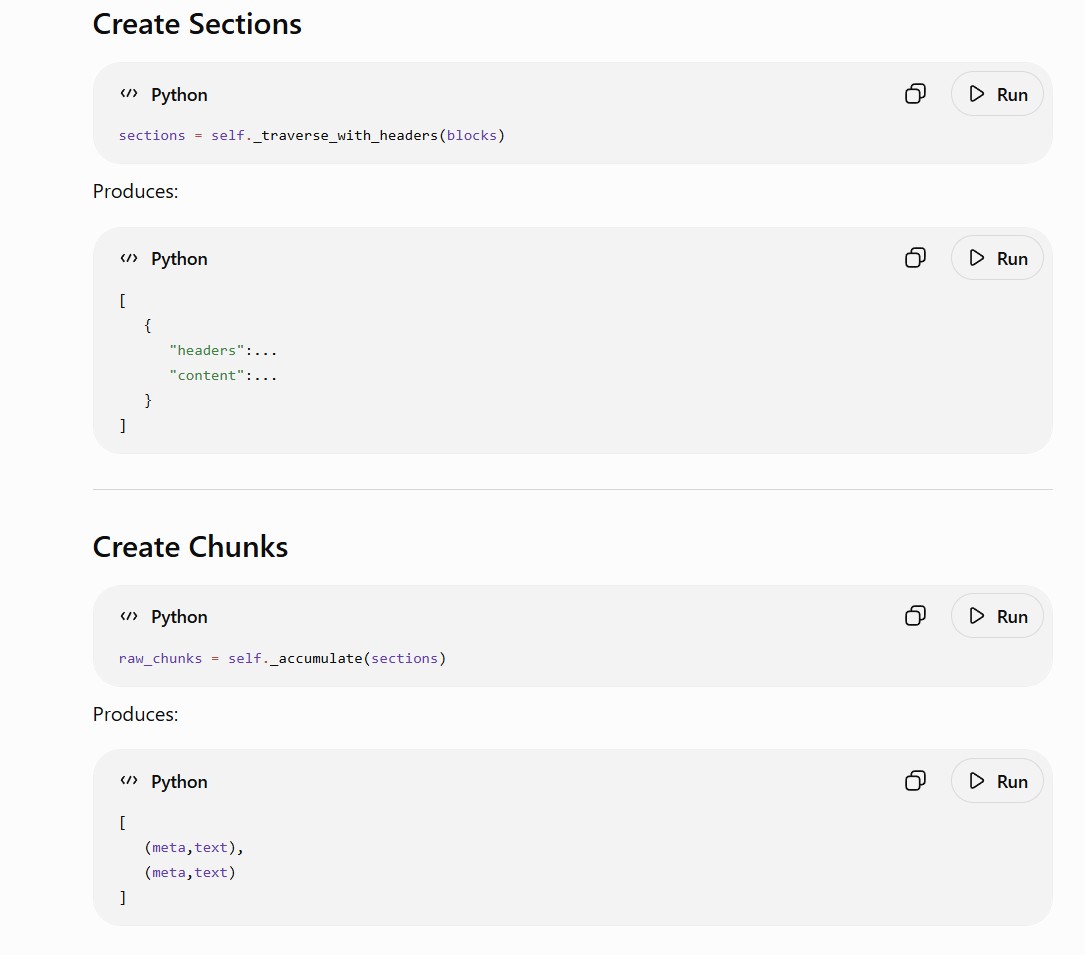
        header_docs = self._hydrate_header_context(self._header_split(text))
        final: list[tuple[dict, str]] = []

        for d in header_docs:
            meta = {
                "h1": d.metadata.get("h1"),
                "h2": d.metadata.get("h2"),
                "h3": d.metadata.get("h3"),
                "h4": d.metadata.get("h4"),
            }
            # Each header section may still split into multiple content chunks.
            for chunk_text in self._split_content(d.page_content):
                if chunk_text and chunk_text.strip():
                    final.append((meta, chunk_text))

        # Greedy linear merge for larger average chunk size.
        # Keep earliest metadata while preserving all content.
        stabilized: list[tuple[dict, str]] = []
        buffer_text = ""
        buffer_meta: dict[str, Any] = {}

        for meta, text in final:
            if not text or not text.strip():
                continue
            if not buffer_text:
                buffer_text = text
                buffer_meta = dict(meta)
                continue

            candidate = f"{buffer_text}\n\n{text}"
            if len(candidate) <= self.max_chars:
                buffer_text = candidate
                buffer_meta = _merge_meta_keep_earliest(buffer_meta, meta)
            else:
                stabilized.append((buffer_meta, buffer_text))
                buffer_text = text
                buffer_meta = dict(meta)

        if buffer_text:
            stabilized.append((buffer_meta, buffer_text))

        # Build output docs; inject source/context once per chunk.
        out = []
        for meta, chunk_text in stabilized:
            prefix = _context_prefix(meta, source_name)
            body = chunk_text if (prefix and chunk_text.startswith(prefix)) else f"{prefix}{chunk_text}"

            chunk_id = len(out) + 1
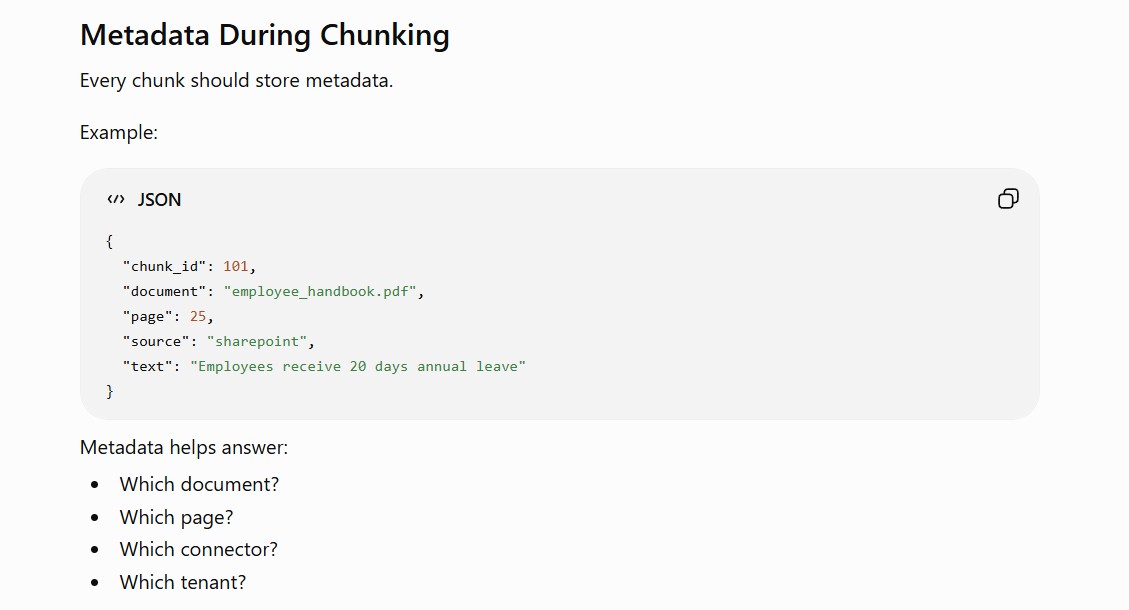
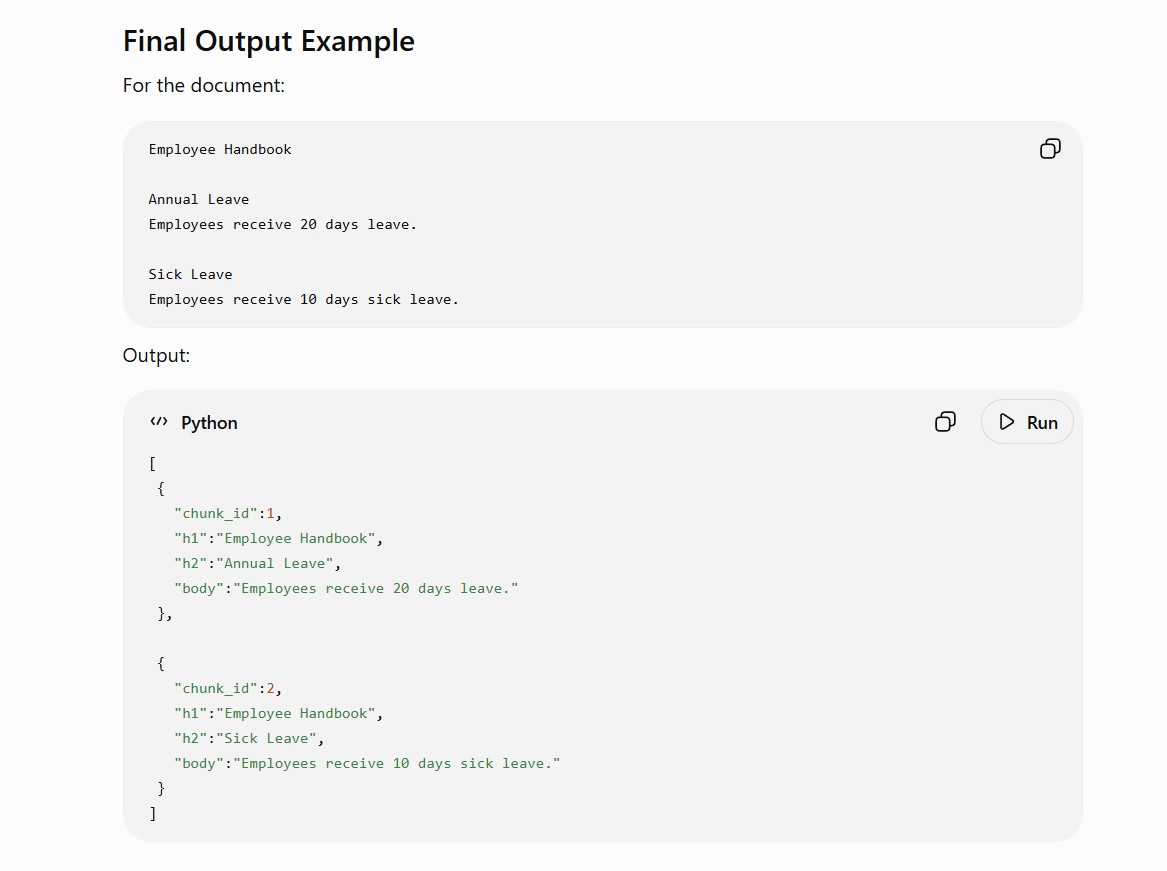
            doc_out = {
                "chunk_id": chunk_id,
                "h1": meta.get("h1"),
                "h2": meta.get("h2"),
                "h3": meta.get("h3"),
                "h4": meta.get("h4"),
                "body": body,
            }
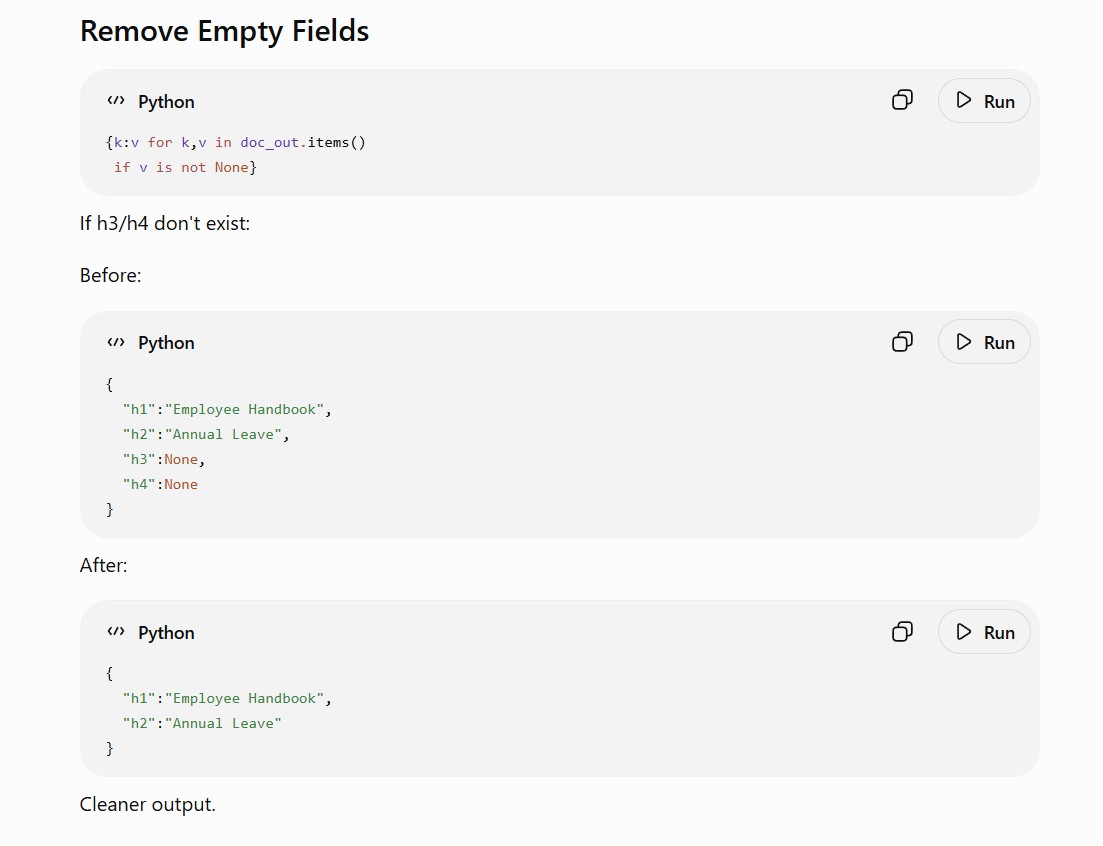
            out.append({k: v for k, v in doc_out.items() if v is not None})

        self.logger.info(f"Chunked {file_name} into {len(out)} chunks")
        return out


def _chunk_content_bytes(payload: bytes, object_name: str) -> list[dict]:
    """Chunk one parsed object payload into in-memory chunk records.

    Routing is extension-based:
    - ``.json``: treated as raw DocAI response(s), chunked via DocAIChunker
    - ``.md``: treated as markdown, chunked via DocumentChunker
    """
    suffix = Path(object_name).suffix.lower()

    if suffix == ".json":
        loaded = json.loads(payload.decode("utf-8"))
        chunker = DocAIChunker()
        file_name = Path(object_name).name

        if isinstance(loaded, list):
            out: list[dict] = []
            for response in loaded:
                if not isinstance(response, dict):
                    continue
                out.extend(chunker.chunk(response, file_name=file_name))
            for idx, chunk in enumerate(out, start=1):
                chunk["chunk_id"] = idx
            return out

        if isinstance(loaded, dict):
            return chunker.chunk(loaded, file_name=file_name)

        raise ValueError("Unsupported DocAI JSON shape; expected dict or list[dict]")

    if suffix == ".md":
        markdown_text = payload.decode("utf-8")
        return DocumentChunker().chunk(markdown_text, file_name=Path(object_name).name)

    logging.getLogger(__name__).error(
        "Unsupported parsed file format for chunking | object=%s | expected=.md or .json",
        object_name,
    )
    raise ValueError(
        f"Unsupported parsed file format '{suffix or '<none>'}' for '{object_name}'. Expected .md or .json"
    )


async def chunk_files(
    input_bucket: str,
    input_prefix: str | None = None,
    output_bucket: str | None = None,      # 🔥 NEW
    output_prefix: str | None = None,
) -> dict:

    logger = logging.getLogger(__name__)
    cfg = get_settings()

    concurrency = int(cfg.get("chunking", {}).get("batch", {}).get("max_concurrency", 5))
    semaphore = asyncio.Semaphore(max(1, int(concurrency)))

    gcs = GCSBucketConnector()

    # 🔥 SAME LOGIC AS PARSER
    destination_bucket = output_bucket or input_bucket

    object_names = await gcs.list_files(input_bucket, prefix=input_prefix)
    object_names = [name for name in object_names if not name.endswith("/")]

    async def _run_one(object_name: str) -> dict:

        result = {
            "gcs_uri": f"gs://{input_bucket}/{object_name}",
            "output_gcs_uri": None,
            "status": "failed",
            "chunks_count": 0,
            "chunks": [],
            "error": None,
        }

        async with semaphore:
            try:
                logger.info(f"Chunking file | {object_name}")

                # – ---------------------------
                # Download parsed file
                # – ---------------------------
                payload = await gcs.download(input_bucket, object_name)

                if not isinstance(payload, bytes):
                    raise TypeError(f"Downloaded object is not bytes for '{object_name}'")

                # – ---------------------------
                # Chunk content
                # – ---------------------------
                chunks = await asyncio.to_thread(
                    _chunk_content_bytes,
                    payload,
                    object_name
                )

                result["status"] = "success"
                result["chunks_count"] = len(chunks)
                result["chunks"] = chunks

                # – ---------------------------
                # 🔥 SAVE CHUNKS TO GCS
                # – ---------------------------
                if output_prefix:

                    file_name = Path(object_name).stem
                    output_object = f"{output_prefix}/{file_name}_chunks.json"

                    output_bytes = json.dumps(
                        chunks,
                        ensure_ascii=False,
                        indent=2
                    ).encode("utf-8")

                    await gcs.save(
                        destination_bucket,   # 🔥 FIXED
                        output_object,
                        data=output_bytes,
                        content_type="application/json"
                    )

                    result["output_gcs_uri"] = f"gs://{destination_bucket}/{output_object}"

                return result

            except Exception as exc:
                err = _error_payload(exc)
                result["error"] = err

                logger.error(
                    f"Failed chunking file | {object_name} | "
                    f"{err['type']} | {err['message']}"
                )

                return result

    # – ---------------------------
    # RUN ALL FILES
    # – ---------------------------
    logger.info(
        f"Starting chunking | input_bucket={input_bucket} | input_prefix={input_prefix} | "
        f"output_bucket={destination_bucket} | total_files={len(object_names)}"
    )

    results = await asyncio.gather(*[_run_one(name) for name in object_names]) if object_names else []

    succeeded = sum(1 for item in results if item.get("status") == "success")
    failed = len(results) - succeeded

    return {
        "input_bucket": input_bucket,
        "input_prefix": input_prefix,
        "output_bucket": destination_bucket,   # 🔥 NEW
        "processed": len(results),
        "succeeded": succeeded,
        "failed": failed,
        "results": results,
    }