
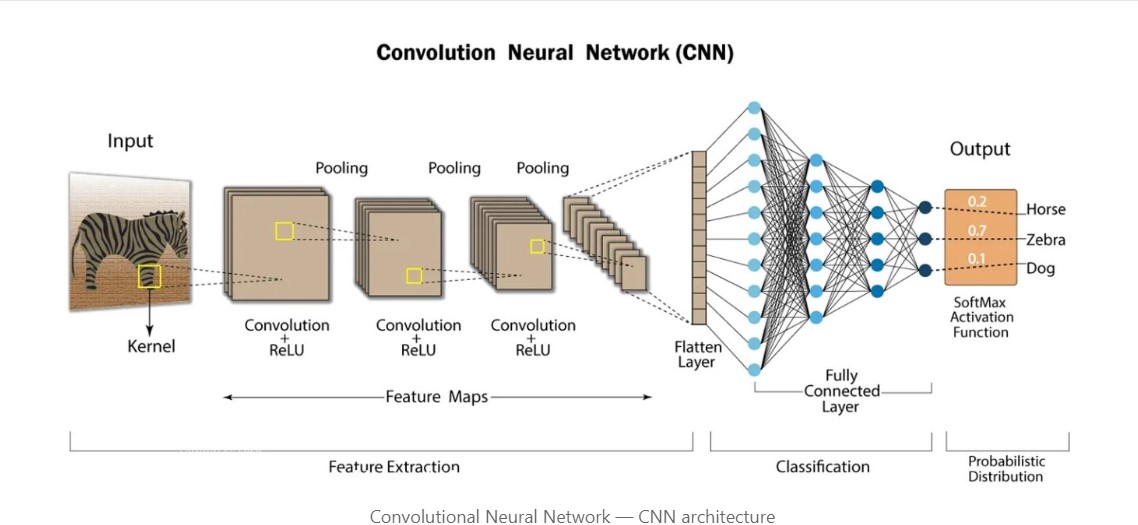
Convolutional Neural Networks
Syllabus:
1. Fundamentals of CNNs
- What are CNNs?
- Differences between CNNs and fully connected networks.
- Applications of CNNs.
- Components of CNNs
- Convolution layers.
- Filters (Kernels) and their role.
- Stride, Padding, and their effects.
- Activation Functions
- ReLU, Sigmoid, Tanh, etc.
- Pooling Layers
- Max pooling, Average pooling, Global pooling.
- Fully Connected Layers
- How they integrate features learned from convolutional layers.
2. Advanced Architectures and Concepts
- Popular CNN Architectures
- LeNet, AlexNet, VGG, ResNet, Inception, MobileNet, EfficientNet.
- Residual Networks (ResNets)
- Skip connections and their significance.
- Inception Networks
- Factorized convolutions and mixed architecture.
- Depthwise Separable Convolutions
- Efficiency in MobileNet and EfficientNet.
- Dilated (Atrous) Convolutions
- For increasing receptive fields without losing resolution.
- Group Convolutions
- In architectures like ResNeXt.
3. Techniques to Improve Performance
- Batch Normalization
- Reducing internal covariate shift.
- Dropout
- Preventing overfitting.
- Data Augmentation
- Random cropping, flipping, rotation, etc.
- Transfer Learning
- Pretrained models and fine-tuning.
- Learning Rate Scheduling
- Warm restarts, step decay, etc.
4. Training CNNs
- Loss Functions
- Cross-entropy, Mean Squared Error (MSE), etc.
- Optimization Algorithms
- SGD, Adam, RMSprop, etc.
- Weight Initialization Techniques
- Xavier, He initialization.
- Overfitting and Underfitting
- Techniques to mitigate both.
5. Applications and Use Cases
- Image Classification
- Multi-class, binary, and multi-label classification.
- Object Detection
- YOLO, SSD, Faster R-CNN.
- Semantic Segmentation
- Fully Convolutional Networks (FCNs), U-Net.
- Image Generation
- GANs and Variational Autoencoders (VAEs).
- Super-resolution and Image Enhancement
6. Specialized Topics
- Attention Mechanisms in CNNs
- Self-attention, Squeeze-and-Excitation Networks.
- Capsule Networks
- Handling spatial hierarchies better than traditional CNNs.
- 3D Convolutions
- For video and volumetric data processing.
- Recurrent Convolutional Networks
- Combining CNNs and RNNs for sequence data.
7. Practical Tools and Libraries
- Deep Learning Frameworks
- TensorFlow/Keras, PyTorch.
- Visualization Tools
- TensorBoard, Grad-CAM.
- Deployment
- ONNX, TensorRT, CoreML.
8. Real-World Challenges
- Data Imbalance
- Techniques like SMOTE, oversampling.
- Computational Efficiency
- Quantization, pruning, knowledge distillation.
- Explainability
- Interpreting CNN decisions (e.g., Grad-CAM).