Example – 1: Document Embedding for Semantic Search
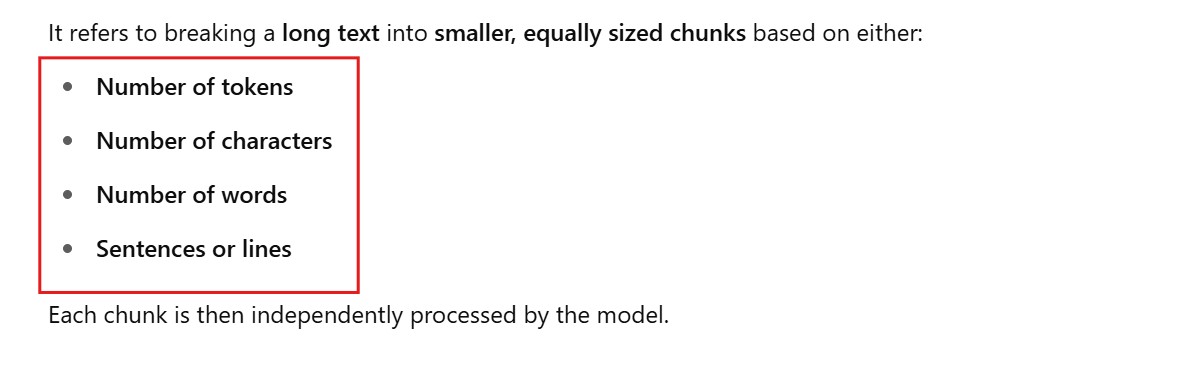
Use case: Splitting a long article into 512-token chunks for embedding in a vector database.
from transformers import GPT2Tokenizer

tokenizer = GPT2Tokenizer.from_pretrained("gpt2")

text = "Your very long document goes here..."
tokens = tokenizer.encode(text)

chunk_size = 512
chunks = [tokens[i:i + chunk_size] for i in range(0, len(tokens), chunk_size)]

# Convert back to text chunks
text_chunks = [tokenizer.decode(chunk) for chunk in chunks]
Example – 2: Preprocessing PDF or Book for LLM Input
Example: A 20,000-character textbook is split into 1000-character chunks before feeding to GPT for summarization.
chunk_size = 1000
chunks = [text[i:i+chunk_size] for i in range(0, len(text), chunk_size)]
Example – 3: Chunking a Transcript
Use case: A meeting transcript is split into fixed-size segments of 30 lines for summary.
lines = transcript.split("\n")
chunk_size = 30
chunks = [lines[i:i+chunk_size] for i in range(0, len(lines), chunk_size)]